




Why You Need It
Most WordPress sites load the same CSS and JavaScript on every page, even when not needed. Assets Manager lets you disable specific assets on specific pages, reducing page weight.
How to Enable this Feature
Step 1: Navigate to Settings
Click into the Classic Monks plugin settings, then the Performance tab, Assets Manager subtab.
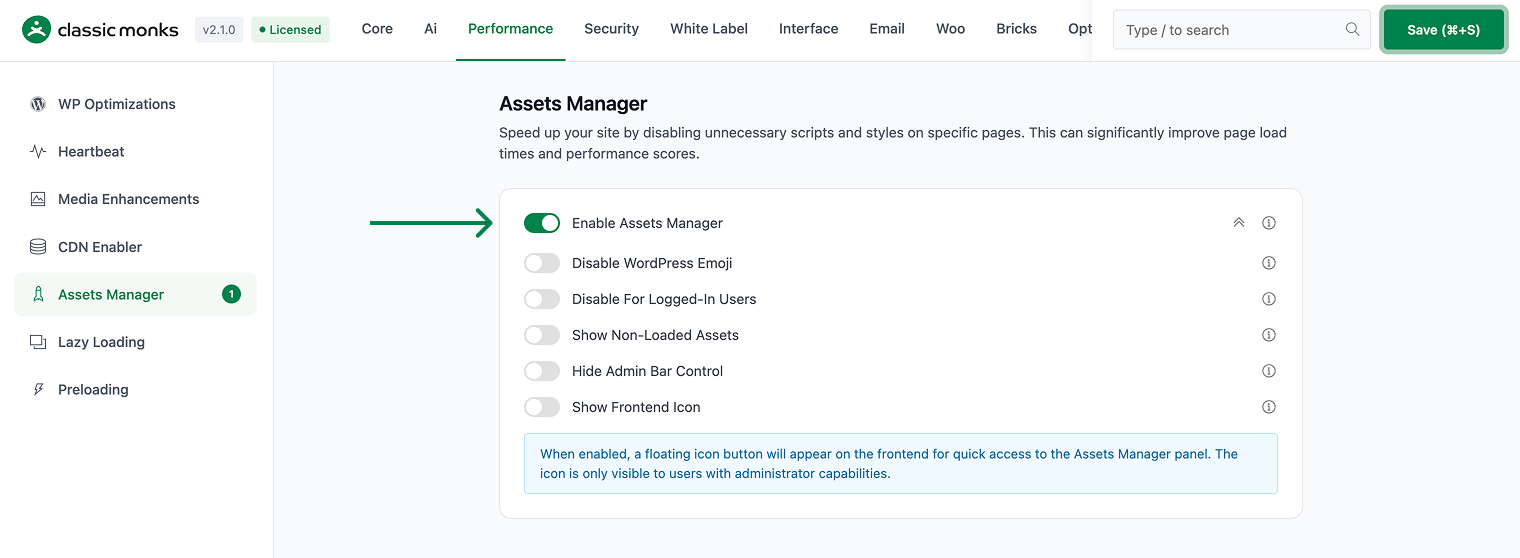
Step 2: Enable the Feature
Toggle on the feature.
Step 3: Save and Test
Click Save Changes. Test on the frontend.
Common Use Cases
Blog posts
Blog posts typically don’t need WooCommerce JavaScript. Disabling WooCommerce assets on blog posts improves load time.
Landing pages
Custom landing pages may not need plugin assets. Disabling them improves page speed.
Developer integration
This feature registers 6 WordPress hooks in assets-manager.php:
Actions:
plugins_loadedcallsCM_Assets_Manager_Module::initialize()(Main entry point (priority 20))template_redirectcallsdetect_content_type()(Detects content type for asset rules (priority 5))wp_print_stylescallsunload_enqueued_styles()(Dequeues disabled styles (priority 100000))wp_print_scriptscallsunload_enqueued_scripts()(Dequeues disabled scripts (priority 100000))wp_footercallsunload_enqueued_styles()(Footer style dequeue for WP 6.9+ (priority 1))wp_ajax_cm_assets_manager_updatecallshandle_ajax_update()(AJAX handler for saving rules)
// Hooked in assets-manager.php
add_action( 'plugins_loaded', 'CM_Assets_Manager_Module::initialize' );
The feature modifies WordPress behavior by registering or removing hooks. Disabling it reverses those changes and WordPress returns to its default behavior.
Before you enable this feature
- Test on staging first to verify no conflicts with your theme or other plugins
- Check dependent plugins that may rely on the functionality being modified
- Monitor after enabling for any unexpected behavior on the frontend
How it works under the feature
This feature runs during the WordPress initialization phase. When enabled, its PHP code registers hooks that modify specific WordPress behaviors. The changes are non-destructive and reversible.
No database schema changes are made. The feature state is stored as a boolean value in the wp_options table and can be toggled at any time from the admin settings.

Add your first comment to this post