




Prerequisites
All four installation methods require the Enable Advanced Plugin Manager master toggle to be on. In the Classic Monks Core tab, Plugins subtab:
- Toggle on Enable Advanced Plugin Manager (the
«submenu indicator shows it adds the Plugin Manager submenu) - Toggle on the specific installation method you want
- Reload the admin page for the Plugin Manager submenu to appear
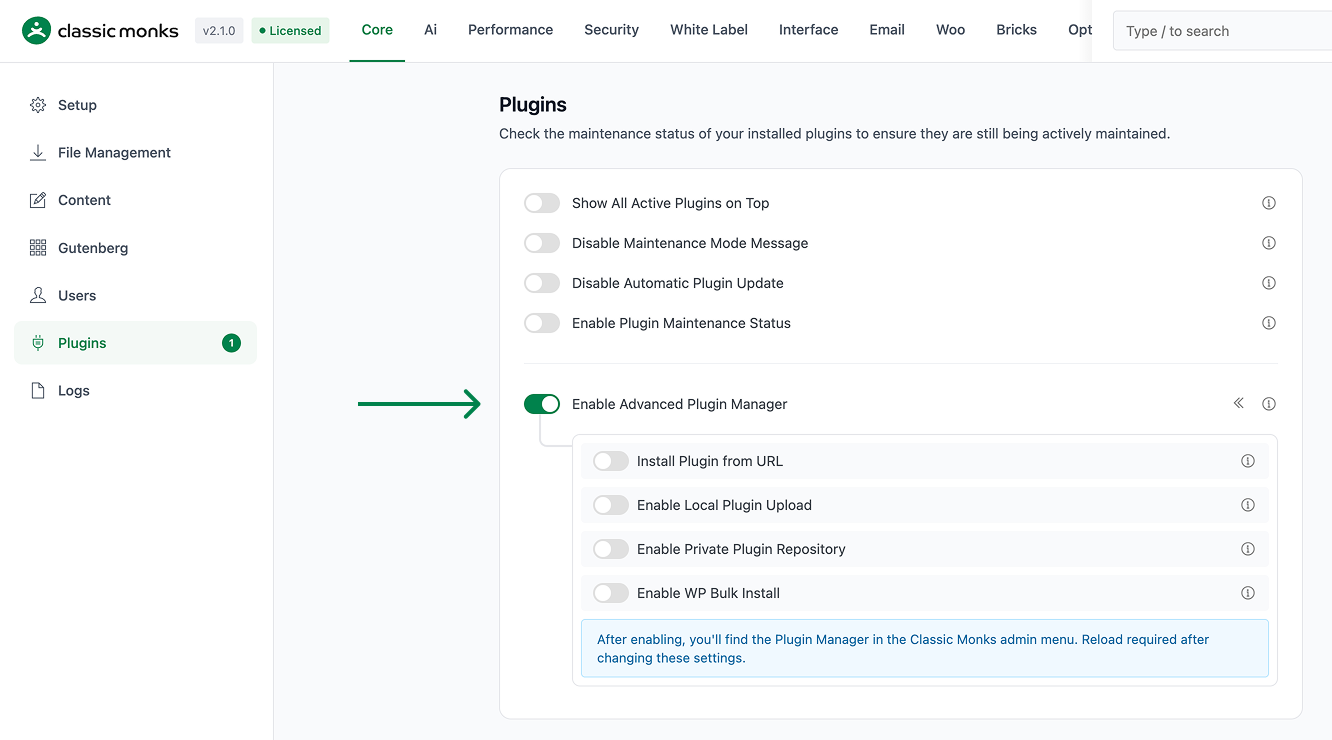
Click Classic Monks > Plugin in the WordPress admin menu to open the Plugin Manager.
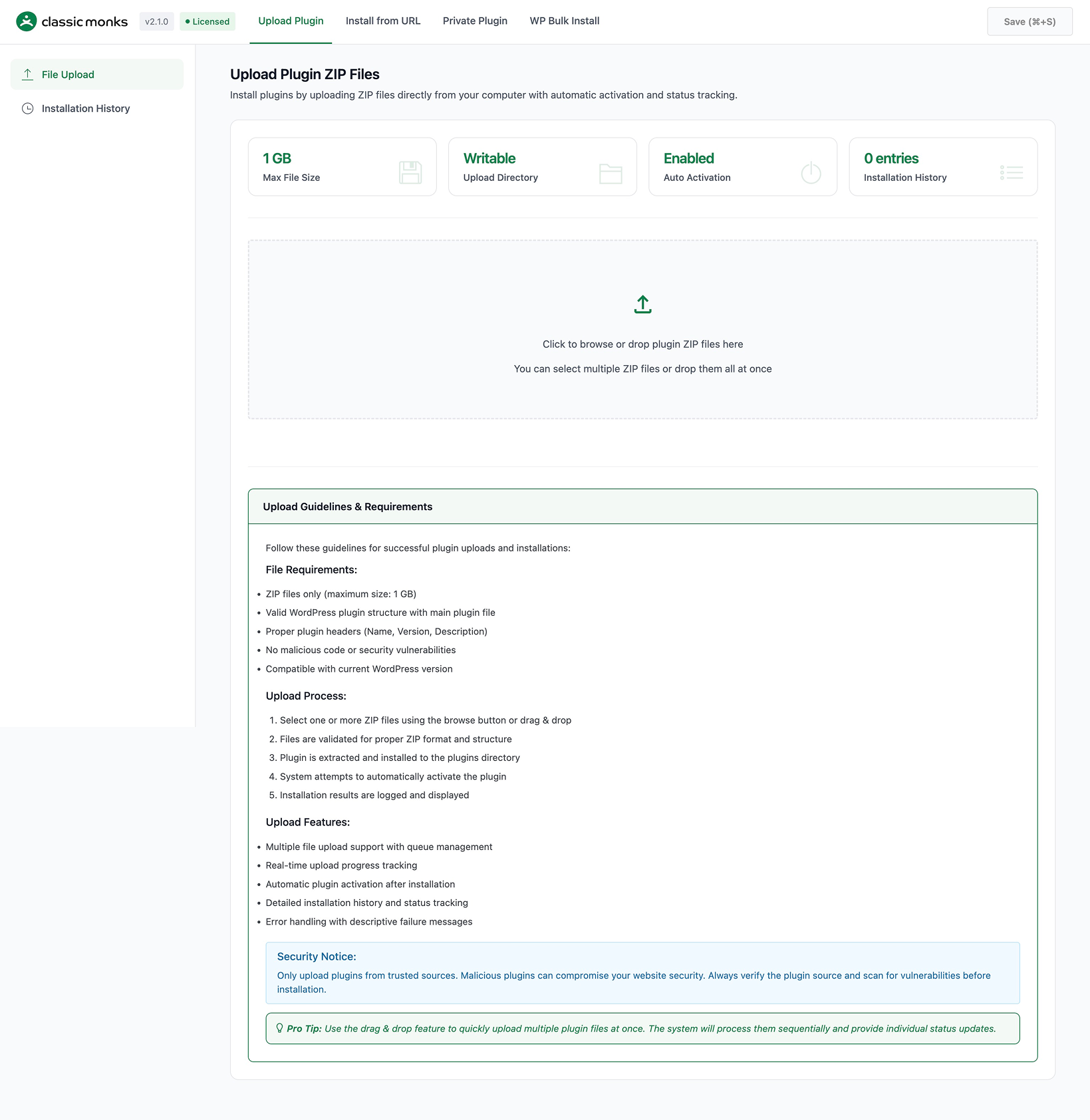
Method 1: Install from URL
Install plugins directly from a ZIP file URL without downloading to your local computer first.
Step 1: Enable Install Plugin from URL
In the Classic Monks Core tab, Plugins subtab, enable:
- Enable Advanced Plugin Manager (master toggle)
- Install Plugin from URL (sub-toggle)
Step 2: Open the URL Install Tab
Click Classic Monks > Plugin, then click the Install from URL tab.
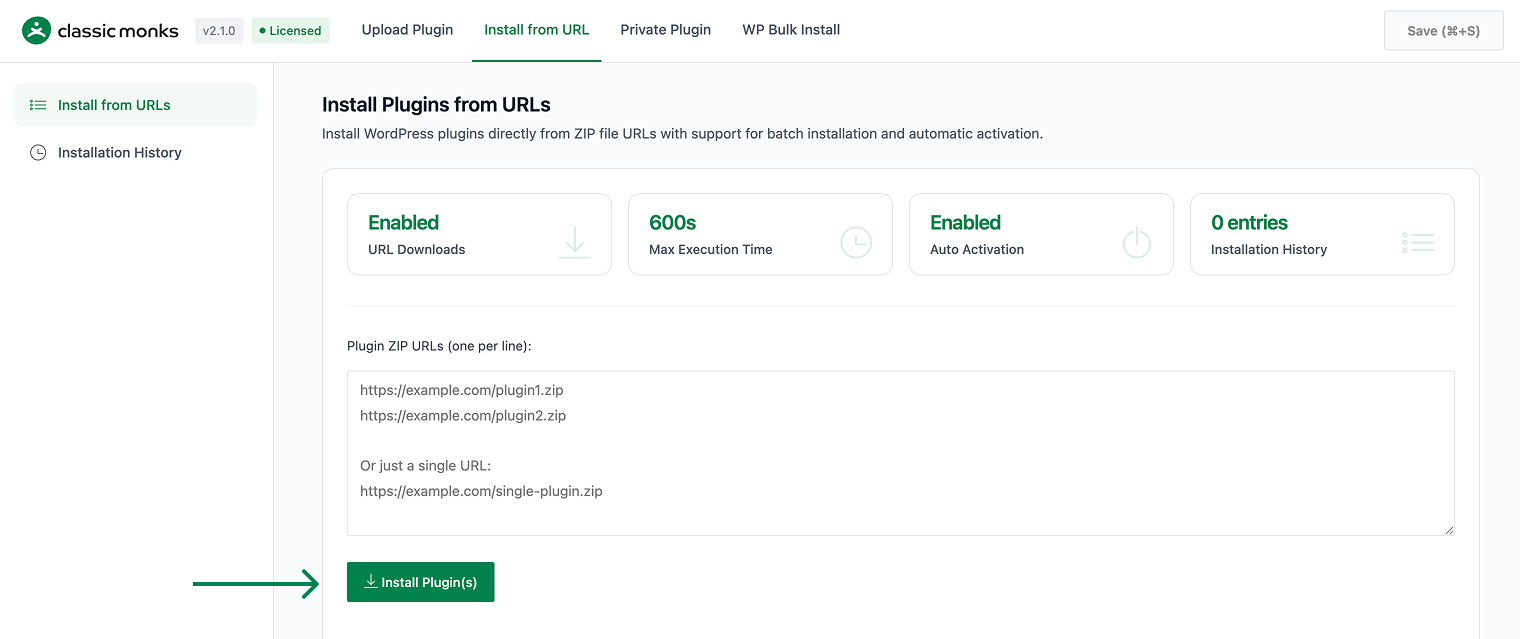
Step 3: Enter the ZIP URL
Paste the full URL to the plugin ZIP file. The URL must be:
- Publicly accessible (or accessible to your server’s IP)
- A direct link to a ZIP file (not a landing page or HTML wrapper)
- Served over HTTPS for security (HTTP works but is not recommended)
Step 4: Install
Click Install. The Plugin Manager downloads the ZIP, validates the structure, extracts to the plugins directory, and optionally activates the plugin.
Supported URL Types
| URL Type | Supported | Notes |
|---|---|---|
| WordPress.org plugin ZIPs | Yes | Direct link to a plugin’s ZIP |
| GitHub release ZIPs | Yes | Use the direct download link from a release |
| S3 / GCS / Azure Blob URLs | Yes | Public bucket URLs work |
| Private CDN with auth headers | No | Auth header support is not built in |
| Landing pages or HTML pages | No | Must be a direct link to a ZIP file |
| Password-protected URLs | No | No UI for password input |
Security Considerations
- The Plugin Manager validates the ZIP structure before extraction, but cannot verify the contents are safe
- Install only from trusted sources
- The download happens server-to-server; your server’s IP may be logged by the URL host
- HTTPS is recommended to prevent MITM tampering
Method 2: Local Plugin Upload
Enhanced version of the default WordPress plugin uploader with better progress tracking, error handling, and ZIP validation.
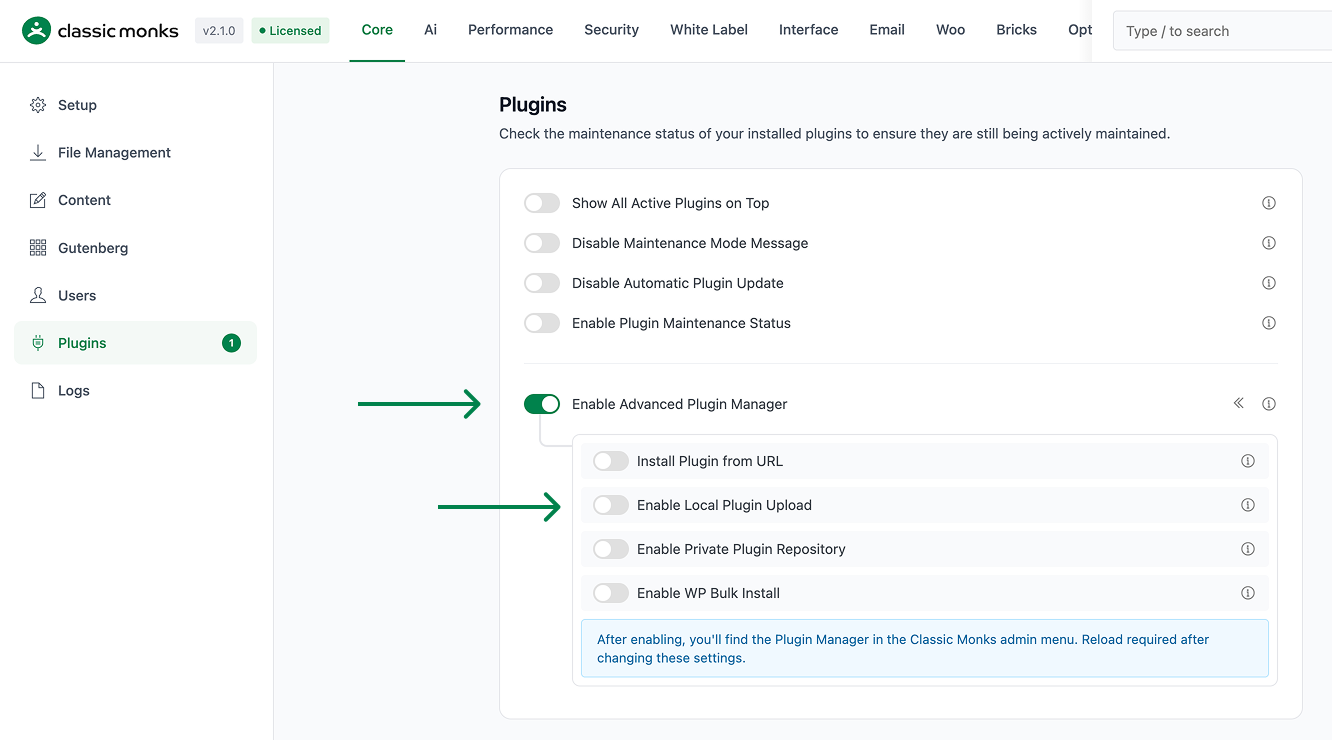
Step 1: Enable Local Plugin Upload
In the Classic Monks Core tab, Plugins subtab, enable:
- Enable Advanced Plugin Manager (master toggle)
- Enable Local Plugin Upload (sub-toggle)
Step 2: Open the Local Upload Tab
Click Classic Monks > Plugin, then click the Local Upload tab.
Step 3: Choose the Plugin ZIP
Click Choose File (or drag and drop). Select the plugin ZIP file from your computer.
Step 4: Upload and Install
Click Install Now. The Plugin Manager uploads the ZIP with progress tracking, validates the structure, extracts to the plugins directory, and shows a success or error message.
Improvements Over Default WordPress Uploader
| Feature | Default WordPress | Classic Monks Enhanced |
|---|---|---|
| Progress tracking | Basic | Real-time upload progress |
| Error messages | Generic | Specific (file too large, invalid ZIP, etc.) |
| Large file handling | Limited by PHP settings | Better timeout handling |
| ZIP validation | After upload | Before extraction |
| Drag-and-drop | No | Yes (in supported browsers) |
Supported File Types
| File Type | Supported | Notes |
|---|---|---|
.zip |
Yes | Standard WordPress plugin ZIPs |
.tar.gz |
No | WordPress does not support tar.gz plugins |
| Password-protected ZIPs | No | No UI for password input |
| Multi-folder ZIPs | Yes | As long as the top level is a valid plugin |
Method 3: Google Drive Plugin Repository
Use Google Drive as a centralized plugin distribution source. Authenticate with Google API, browse your Drive folder, and install plugins.
Step 1: Enable Private Plugin Repository
In the Classic Monks Core tab, Plugins subtab, enable:
- Enable Advanced Plugin Manager (master toggle)
- Enable Private Plugin Repository (sub-toggle)
Step 2: Open the Private Repository Tab
Click Classic Monks > Plugin, then click the Private Plugin tab.
Step 3: Set Up Google API Credentials
You will need:
- A Google Cloud project with the Google Drive API enabled
- OAuth 2.0 credentials (Client ID and Client Secret)
- A configured OAuth consent screen
The Plugin Manager walks you through creating these credentials in the Google Cloud Console.
Step 4: Authenticate with Google
Click Connect to Google Drive. You will be redirected to Google’s OAuth flow. Sign in with the Google account that has access to the Drive folder containing your plugins.
Step 5: Select the Drive Folder
After authentication, browse your Drive folders. Select the folder that contains the plugin ZIPs you want to make available.
Step 6: Save Settings
Click Save Settings. The Drive folder is now linked.
Step 7: Install Plugins
Open the Plugin Manager’s Private Repository tab. The Plugin Manager lists all plugin ZIPs in the selected Drive folder. Click Install next to the plugin you want.
Method 4: WordPress.org Author Search
Find all plugins by a specific WordPress.org author and install multiple at once.
Step 1: Enable WP Bulk Install
In the Classic Monks Core tab, Plugins subtab, enable:
- Enable Advanced Plugin Manager (master toggle)
- Enable WP Bulk Install (sub-toggle)
Step 2: Open the Author Search Tab
Click Classic Monks > Plugin, then click the WP Bulk Install tab.
Step 3: Enter an Author Slug
Enter the WordPress.org author slug (the username portion of the author’s profile URL, e.g., developer-name from wordpress.org/developers/developer-name).
Step 4: Search and Install
Click Search. The Plugin Manager queries the WordPress.org API and lists all plugins by that author. Select the plugins you want and click Install.
Configuration Options
| Option | Description | Default |
|---|---|---|
| Enable Advanced Plugin Manager | Master toggle for the entire feature set. | Off |
| Install Plugin from URL | Enables URL-based installation. | Off |
| Enable Local Plugin Upload | Enables enhanced local upload. | Off |
| Enable Private Plugin Repository | Enables Google Drive integration. | Off |
| Enable WP Bulk Install | Enables WordPress.org author search. | Off |
Common Use Cases
Installing a Plugin from a Private Mirror
You maintain a private S3 bucket with your custom plugins. Generate a signed URL, paste it in the Plugin Manager, install.
Installing from a Client’s CDN
The client provides a URL to a custom plugin hosted on their CDN. Install directly without downloading.
Installing Pre-Releases from GitHub
The plugin author publishes pre-release ZIPs on GitHub. Use the GitHub release’s direct download URL.
Installing a Custom Plugin You Developed
You built a custom plugin for a client. ZIP the plugin directory, upload through the Plugin Manager.
Installing a Premium Plugin
You purchased a premium plugin from a marketplace. Download the ZIP from your account, upload through the Plugin Manager.
Agency Plugin Distribution
Use Google Drive as a centralized plugin repository. Share one Drive folder across all client sites. Each site authenticates and installs from the same source.
Bulk-Installing Author Plugins
Find a WordPress.org author whose plugins you use across multiple sites. Search by author slug, select all their plugins, and install in one batch.
Developer Notes
Each installation method adds its own input field to the Plugin Manager. No developer hooks are currently exposed for the installation methods.
Options used:
| Option | Type | Default |
|---|---|---|
enable_plugin_manager |
Boolean | false |
enable_plugin_install_from_url |
Boolean | false |
enable_local_plugin_upload |
Boolean | false |
enable_private_plugin_repo |
Boolean | false |
enable_wp_bulk_install |
Boolean | false |
The Plugin Manager implementation is in functions/plugin-manager/ with separate files for each method: install-from-url.php, upload-plugin.php, private-plugin-repo.php, wp-bulk-install.php.

Add your first comment to this post