




What Is the Site-Wide Password Protection feature?
Site-Wide Password Protection requires a password to access any content on your WordPress site. Visitors see a password prompt before they can view any page, post, or media.
This is different from Custom Login URL (which changes the URL) or Login Lockdown (which limits failed attempts). Site-Wide Password Protection is a wall in front of the entire site.
Why You Need It
Site-Wide Password Protection is useful for:
- Staging sites: Hide a work-in-progress site from public access
- Pre-launch sites: Keep the site private until launch
- Member-only sites: Require a password to view any content
- Temporary sites: Quick way to make a site private (e.g., for a contest)
- Beta sites: Get feedback from a limited audience before public launch
For most production sites, this is too restrictive. For staging or pre-launch, it’s essential.
How to Use Site-Wide Password Protection in WordPress
Step 1: Navigate to Settings
Click into the Classic Monks plugin settings in your WordPress dashboard.
Step 2: Go to the Security Tab
Click on the Security menu, then click the Content Protection subtab.
Step 3: Enable Site-Wide Password Protection
Scroll to Enable Site-Wide Password Protection and toggle on. Nested options expand.
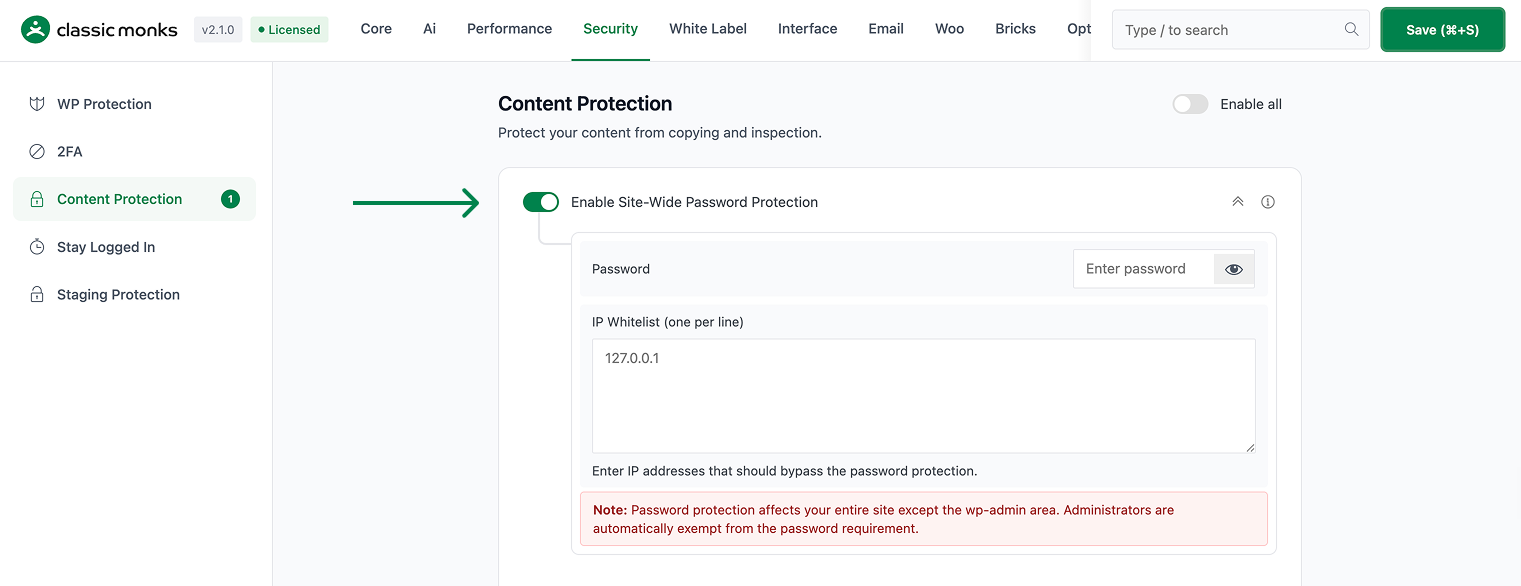
Step 4: Configure the IP Whitelist (Optional)
Add trusted IPs to the IP Whitelist field (one per line). These IPs bypass the password requirement:
- Office IP addresses
- Your home IP (for development)
- Search engine bots (if you want them to index the site)
Step 5: Save Changes
Click Save Changes.
Step 6: Test
Log out (or open a private browsing window). Visit any page. You should see a password prompt. Enter the correct password to access the site.
Configuration Options
| Option | Description | Default |
|---|---|---|
| Enable Site-Wide Password Protection | Master toggle. | Off |
| IP Whitelist | IPs that bypass the password requirement. | (empty) |
The password itself is configured in the WordPress settings (Settings > Reading > “Password protect this site”). The Classic Monks feature enhances this built-in WordPress feature with the IP whitelist and other options.
What Gets Affected
- The frontend: all pages require the password
- The admin: still works for logged-in admins
- The search engines: the password page may not be indexable (no content to index)
- The media files: typically not protected (they’re served directly)
What Does NOT Get Affected
- The admin (after login): full access
- The REST API: not protected (use a separate security plugin if needed)
- The cron jobs: not affected
- The IP-whitelisted visitors: full access without password
Advanced Options (Developers)
This feature registers 5 WordPress hooks in password-protection.php:
Actions:
template_redirectcallsCM_Password_Protection::maybe_show_login_form()(Shows password form for protected content)initcallsCM_Password_Protection::maybe_process_login()(Processes password form submission)wp_before_admin_bar_rendercallsCM_Password_Protection::add_password_protection_admin_bar_item()(Adds admin bar indicator)
Filters:
cm_password_protection_error_messagescallsapply_filters()(Customizable filter)cm_password_protection_login_headcallsapply_filters()(Customizable filter)
// Hooked in password-protection.php
add_action( 'template_redirect', 'CM_Password_Protection::maybe_show_login_form' );
The feature modifies WordPress behavior by registering or removing hooks. Disabling it reverses those changes and WordPress returns to its default behavior.

Add your first comment to this post