




What Is the AI Provider?
The AI Provider is the connection between Classic Monks and a model API. Every AI feature in the plugin (the AI Agent, AI Tools, Bricks AI Builder, Vision / Image workflows) routes through whichever provider you select here. You pick one provider as the main text provider, optionally add a separate Vision / Image provider for image-aware tasks, and Classic Monks handles the request shaping, retries, and history for you.
Why You Need It
Without an AI Provider configured, every AI feature in Classic Monks is non-functional. The provider is the bridge between your WordPress admin and the language models that power content generation, image analysis, code review, and chat assistance.
Picking the right provider matters for:
- Cost: Some providers (Gemini Flash, Zhipu GLM) are dramatically cheaper than others for the same task
- Capability: Different models excel at different things (Claude for reasoning, Gemini for multimodal, GPT for general tasks)
- Compliance: Some providers offer data residency, regional hosting, or self-hosted options
- Resilience: OpenRouter aggregates 200+ models behind one key, so a single provider outage does not take you down
How to Configure the AI Provider in Classic Monks
Step 1: Enable AI Features
The AI Provider configuration is hidden until you turn on Enable AI Features in the General subtab. See How to Enable AI Features in Classic Monks.
Step 2: Open the General Subtab
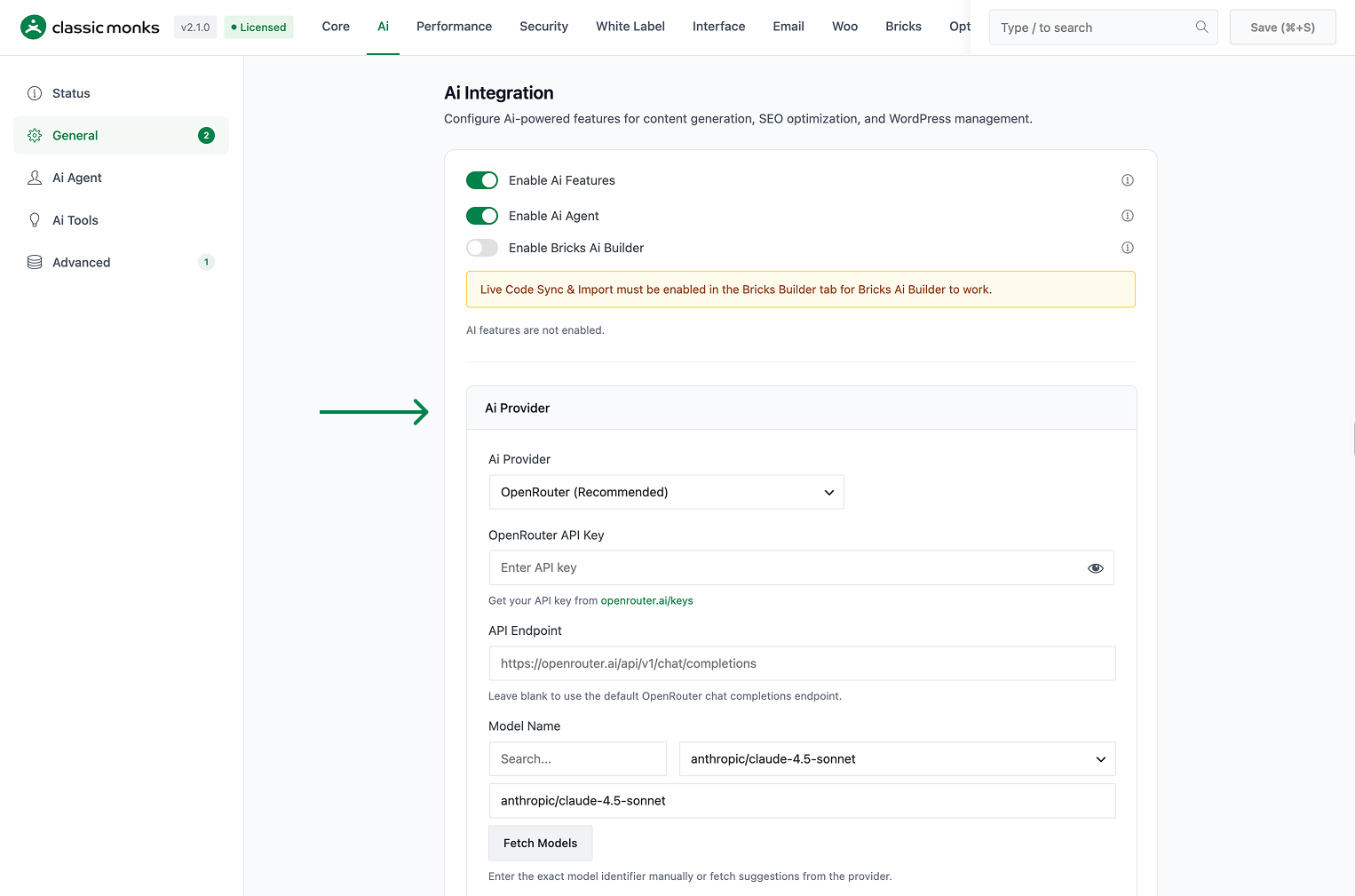
In the AI tab, stay on the General subtab. Scroll to the AI Provider section below the AI Agent and Bricks AI Builder toggles.
Step 3: Choose a Provider
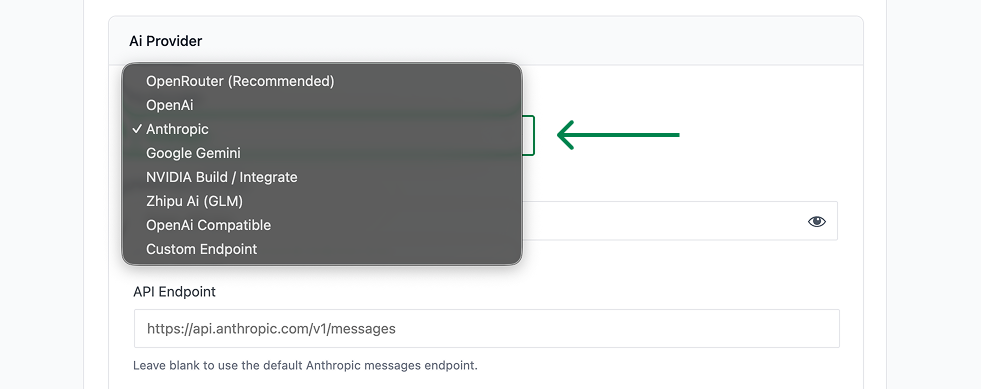
Click the AI Provider dropdown and select one of the 8 supported options. The provider-specific fields appear below the dropdown as soon as you change the selection.
Step 4: Enter Your API Key
Each provider has an API Key password field. The field stores the key when you save. If a key is already saved, the field shows “Saved API key. Leave blank to keep it unchanged.” and the actual value is not rendered to the page.
Get keys from the provider’s dashboard:
- OpenRouter: openrouter.ai/keys
- OpenAI: platform.openai.com/api-keys
- Anthropic: console.anthropic.com/settings/keys
- Google Gemini: aistudio.google.com/app/apikey
- NVIDIA Build / Integrate: NVIDIA dashboard
- Zhipu AI (GLM): z.ai/manage-apikey/apikey-list
- OpenAI Compatible: Your self-hosted or third-party endpoint dashboard
- Custom Endpoint: Whatever service you are connecting to
Step 5: (Optional) Override the Endpoint
Every provider except OpenAI Compatible and Custom Endpoint has a default endpoint URL pre-filled as a placeholder. Leave it blank to use the provider’s default. Override it only if you are proxying through a gateway or running a self-hosted mirror.
Step 6: Choose a Model
Each provider has a model field with two controls:
- A searchable select dropdown that lists models fetched from the provider
- A free-text input for the exact model identifier
- A Fetch Models button that calls the provider’s API and populates the dropdown
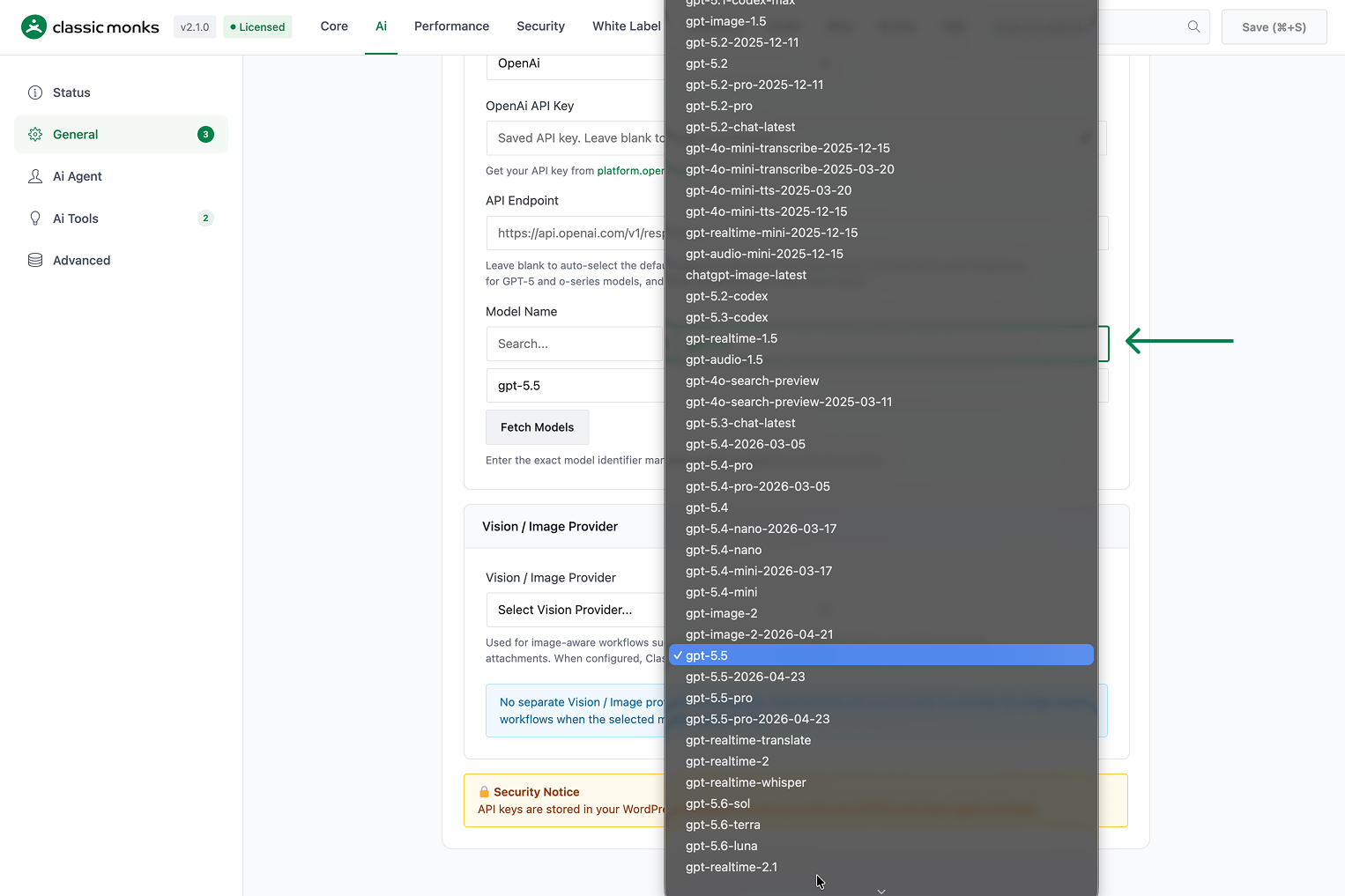
Click Fetch Models after entering your API key to populate the dropdown with models your account has access to. Pick a model from the list, or paste a model ID manually if you know it.
Step 7: Save Changes
Click Save Changes. Classic Monks validates the provider, model, and API key on the next AI request.
Supported Providers
| Provider | Default Model | Best For | Endpoint Override |
|---|---|---|---|
| OpenRouter (Recommended) | anthropic/claude-4.5-sonnet |
Access to 200+ models with one key | Yes |
| OpenAI | gpt-4o |
GPT-5, o-series, and legacy chat models. Auto-routes between Chat Completions and Responses API | Yes |
| Anthropic | claude-3-5-sonnet-latest |
Claude reasoning and coding strength | Yes |
| Google Gemini | gemini-3-flash |
Multimodal tasks, fast inference, generous free tier | Yes (supports {model} placeholder) |
| NVIDIA Build / Integrate | z-ai/glm5 |
GPU-accelerated OpenAI-compatible chat models | Yes |
| Zhipu AI (GLM) | GLM-4.7 |
Chinese and bilingual content | Yes |
| OpenAI Compatible | (none, must specify) | LM Studio, Ollama, Together AI, any OpenAI-format API | Yes (required, base URL) |
| Custom Endpoint | (none, must specify) | Any AI API with separate URL, key, and model | Yes (required) |
Configuration Options
| Option | Description | Default |
|---|---|---|
| AI Provider | Selects which provider powers all AI features. | OpenRouter |
| API Key | Provider-specific key. Stored in WordPress options. | Empty |
| API Endpoint | Optional override of the provider’s default endpoint URL. | Provider default |
| Model Name | The exact model identifier passed in every AI request. | Provider default |
| Fetch Models | Calls the provider’s model-list API and populates the model dropdown. | Button |
Switching Providers
Switching is non-destructive. When you change the AI Provider dropdown:
- The new provider’s fields appear
- Your old provider’s API key, endpoint, and model stay saved in the background
- Switching back to the old provider restores its saved values
You can keep multiple providers configured and switch between them as needed. This is useful for testing model quality, comparing costs, or routing specific workflows to specialized providers (via the Vision / Image Provider).
Security Notice
A warning notice appears at the bottom of the AI Provider section:
API keys are stored in your WordPress database. Ensure your site uses HTTPS and keep regular backups.
Classic Monks stores API keys as WordPress options. They are not encrypted at rest. If your database is compromised, the keys are exposed. Mitigations:
- Use HTTPS on the entire admin
- Restrict database access
- Use the Custom Endpoint provider to point at a proxy that holds the real key
- Rotate keys if you suspect a leak
Developer Notes
Provider configuration is managed through WordPress options. The active provider and model are determined by:
| Option | Type | Description |
|---|---|---|
cm_ai_providers |
Array | List of enabled providers |
cm_ai_provider |
String | Active provider slug |
cm_ai_model |
String | Active model identifier |
The function cm_get_ai_provider() returns the active provider slug, and cm_get_ai_provider_model() returns the active model identifier.
Provider-specific API keys are stored as individual options (e.g., cm_ai_openai_api_key, cm_ai_anthropic_api_key).

Add your first comment to this post