




What Is the Auto-check Remember Me feature?
By default, the WordPress login form has an unchecked “Remember Me” checkbox. Users who want a long session (14 days by default, 30 days with Stay Logged In) need to manually check the box.
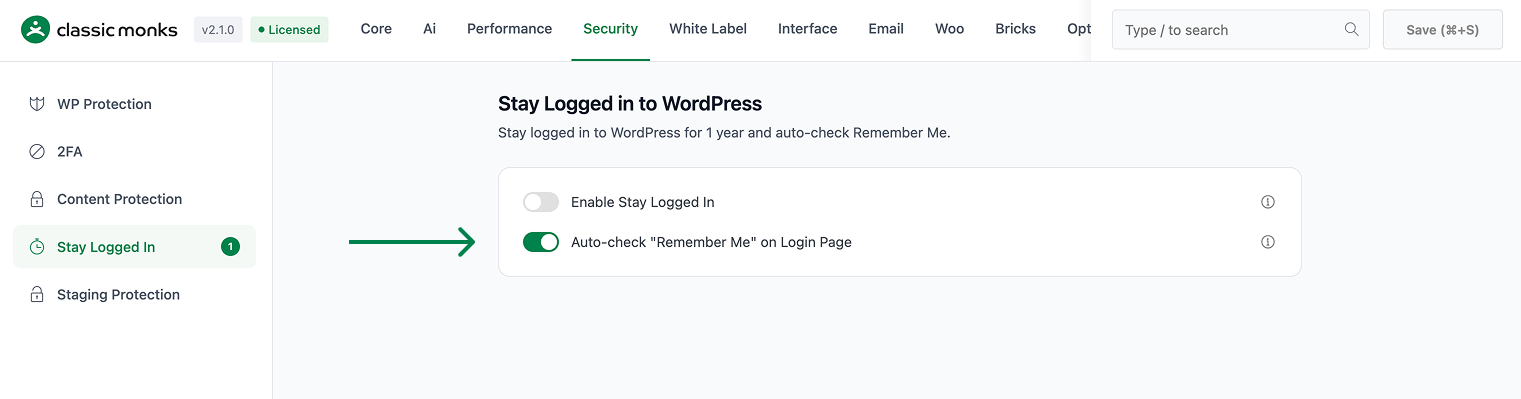
The Auto-check Remember Me feature pre-checks the box on page load, so users automatically get the long session unless they uncheck it.
Why You Need It
The default behavior (unchecked) assumes most users want short sessions. But for many sites, this is the opposite of what users want:
- Most users prefer long sessions: They don’t want to log in every 2 weeks
- Manual check is friction: Forgetting to check means a shorter session
- Forgotten sessions hurt UX: Users who get logged out unexpectedly blame the site, not themselves
- Internal sites: For company intranets or member sites, users expect to stay logged in
The Auto-check Remember Me feature is for sites where long sessions are the default expectation.
Trade-offs vs manual check
Auto-checking has trade-offs:
- Shared devices: Users who share devices (e.g., library computers) may forget to uncheck
- Stolen devices: A stolen device with auto-check has a longer valid session
- Public computers: Kiosks and public computers should never have Remember Me checked
- Compliance: Some regulations require short sessions for sensitive data
For most public-facing sites, the default (unchecked) is appropriate. For internal sites or trusted environments, auto-check is useful.
How to Auto-check Remember Me in WordPress
Step 1: Navigate to Settings
Click into the Classic Monks plugin settings in your WordPress dashboard.
Step 2: Go to the Security Tab
Click on the Security menu, then click the Stay Logged In subtab.
Step 3: Enable Auto-check Remember Me
Scroll to Auto-check Remember Me on Login Page and toggle on.
Step 4: Save Changes
Click Save Changes.
Step 5: Test
Visit the login form. The “Remember Me” checkbox should be pre-checked. If you want a session-only login, uncheck the box before submitting.
Configuration Options
| Option | Description | Default |
|---|---|---|
| Auto-check Remember Me | Master toggle. | Off |
No nested options. The pre-check applies to all users (no per-role control).
What Gets Affected
- The login form: the “Remember Me” checkbox is pre-checked
- The default session duration: users get the long session by default
- The user experience: one less thing to remember to check
What Does NOT Get Affected
- The user’s ability to uncheck: users can still uncheck the box manually
- The session duration itself: still controlled by WordPress core + Stay Logged In
- The wp-admin: not affected (after login)
- The user roles: not affected
Advanced Options (Developers)
This feature registers 1 WordPress hook in stay-logged-in.php:
Actions:
login_footercallscm_remember_me_checked()(Auto-checks Remember Me checkbox on login form)
// Hooked in stay-logged-in.php
add_action( 'login_footer', 'cm_remember_me_checked' );
The feature modifies WordPress behavior by registering or removing hooks. Disabling it reverses those changes and WordPress returns to its default behavior.

Add your first comment to this post